Under NDA · Destination wedding planning
512 wedding enquiries with no paid advertising
A destination wedding agency in Croatia has had 512 enquiries since May 2025 with no paid advertising. Organic clicks doubled year on year while impressions stayed flat.
- Client
- Under NDA
- Sector
- Destination wedding planning in Croatia
- Market
- Couples from the US and UK
- Engagement
- Ongoing SEO, since May 2025
- Published
-
512
enquiries since May 2025, with no paid advertising
-
740 → 1,500
organic clicks, three months year on year
-
1.5% → 2.9%
click-through rate, with impressions flat at about 50K
Context
A boutique destination wedding agency in Croatia. It plans a deliberately small number of luxury weddings a year, from elopements to multi-day island celebrations, for couples flying in mostly from the US and UK. The work is under NDA, so the agency, its site and its competitors are left out.
The site runs to about 130 pages, about half of them individual venue pages. I have run its SEO since May 2025, and the engagement is ongoing.
The problem
It started with one sentence from a client in the US: she couldn’t find the agency on Google Maps, whatever she searched for. That was what prompted the audit, and the audit found a site carrying a decade of accumulated debt.
A redesign was leaking authority. A recent redesign had left old URLs returning 404 while Google still had them indexed, quietly losing years of accumulated authority.
The pages that sell had nothing machine-readable. About 90 of the most commercially important pages carried no structured data at all.
A photography business had no alt text. Almost none of the site’s roughly 1,300 images had any.
The markup was broken in ways nobody could see. A developer had used H1 tags to control font size, leaving one page with 15 of them and the blog with none. Every venue card on one regional hub page linked to the same venue. The landing page for one of the country’s main wedding destinations had under 50 words on it.
Competitors had far more proof. The two market leaders had each published dozens of real weddings. The agency had a handful.
What I did
Fixed the foundation. I rebuilt the local business structured data, which now validates clean in Google’s Rich Results Test, and deployed venue schema across every venue page. I recovered the legacy URLs that were dead-ending, and removed nine empty or duplicate pages that were competing with real ones.
Repaired what was quietly broken. I audited every page and fixed the heading structure where it was wrong: 41 headings retagged, with typography locked at three breakpoints so nothing moved on screen. I wrote nearly 1,200 image alt texts and deployed them through the WordPress API. I found and fixed 13 broken internal links, including the hub page where every venue card pointed to the same place.
Connected the content that already existed. The few real-wedding stories were strong, 750 to 1,400 words each, but completely orphaned, with no internal links in or out. I linked each one to the venues it took place at, and added “weddings we planned here” blocks to those venue pages, so isolated pages became a connected cluster.
Studied the competition page by page. I crawled both national market leaders and the dominant agency in Italy, and measured content depth, link structure and schema coverage on each page. Two findings reshaped the strategy. The leaders win on the number of real weddings they publish, not on page quality. And nobody targets “[city] wedding planner”: everyone competes for “[city] wedding venues”, which leaves the higher-intent hiring queries open.
Rebuilt the strategy around those findings. So far that has produced a new homepage, benchmarked against the Italian market leader, and four new destination hubs, both live. The rest is in the roadmap below.
Result
512 enquiries since May 2025 with no paid advertising. Organic search is the primary acquisition channel.
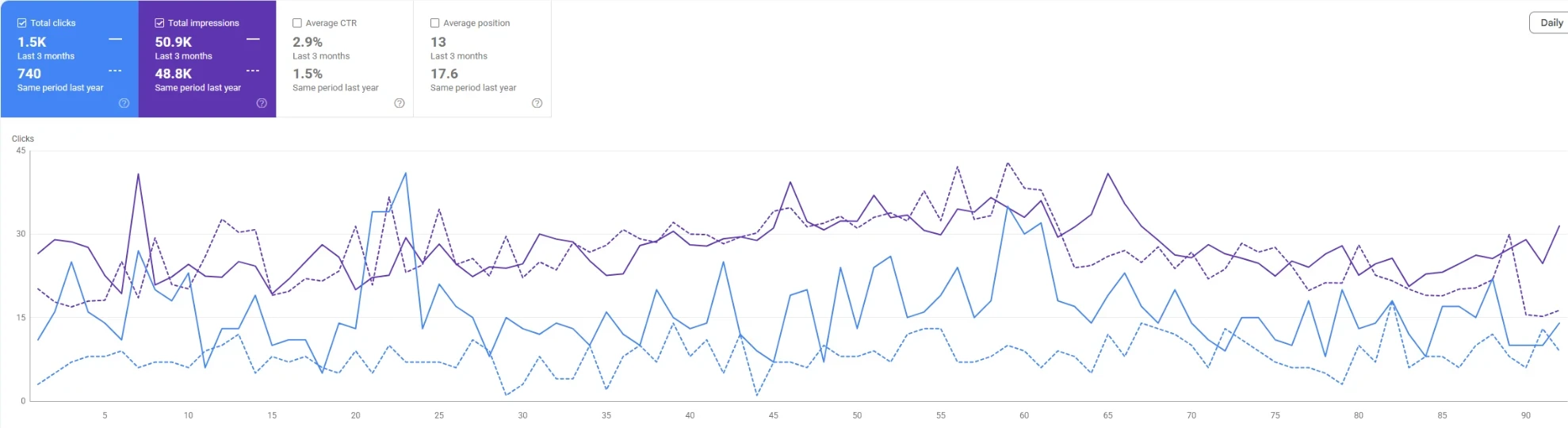
The last three months against the same three months a year earlier, in Google Search Console:
- Organic clicks doubled, from 740 to 1,500.
- Impressions were essentially flat, from 48,800 to 50,900.
- Click-through rate rose from 1.5% to 2.9%.
- Average position improved from 17.6 to 13.
The point
Visibility didn’t increase. The quality of it did. Impressions barely moved while clicks doubled: the site was shown about as often as before, ranked higher when it was, and far more of the people who saw it clicked through.
That is intent matching and relevance, not reach. For a business where a single enquiry can be worth thousands of euros, that distinction is the whole value.
What’s next
The planner queries. A per-city “[city] wedding planner” cluster, aimed at the hiring queries no competitor targets.
Venue partnerships. A list of 46 venues that competitors feature and the agency doesn’t, to approach as partners.
More real weddings. The market leaders win on the number of weddings they publish, and a handful isn’t enough to compete on that. Each new story now has a place to go: linked to its venue, and its venue linked back.
The rest of the roadmap. More than 70 prioritised items, built on the foundation that is now in place.