Under NDA · Healthcare lead generation
Launching lead generation sites in 13 markets
A ccTLD portfolio with a shared entity foundation got new markets producing leads faster. The established market declined in the same period; this covers why.
- Company
- Under NDA
- Sector
- Lead generation in a regulated healthcare vertical
- Scope
- 12 European markets and South Africa
- Role
- Architecture and technical specifications
- Published
-
~½ the time
for a new market to reach half the established market's lead volume
-
12+ months
of stable organic baseline through core updates
-
13
markets, each on its own ccTLD
Context
A lead generation business in a regulated healthcare vertical, operating in 12 European markets and South Africa. The work is under NDA, so the company, its sites and absolute figures are left out.
Problem
Every new market launched from zero: no visibility, no leads. The time it took a new market to start producing enquiries was the limit on how fast the business could expand.
What I did
A country domain per market, not subfolders. Subfolders on one domain consolidate authority faster, and that was the obvious alternative. I chose ccTLDs because local trust signals mattered more in this vertical, and regulation differed enough between countries that the content had to diverge, not just be translated.
A shared entity and structured data foundation. Every property described the same organisation, services and relationships in the same way, then localised the specifics per market: regulation, terminology, providers and proof points.
Hreflang clusters so properties didn’t compete. Markets that share a language were clustered with hreflang, so each country’s own site ranked in that country instead of the properties competing for the same queries.
Cross-property linking. New domains were linked from the established properties, so they didn’t launch into a vacuum.
What I owned
The architecture and the technical specifications. Writers produced the localised content and developers implemented the specs. I briefed both and QA’d what came back.
Result
New market properties launched and held their visibility. One reached roughly half the established market’s lead volume in about half the time, and it has kept a stable organic baseline for over a year, through several core updates.
The counterpoint
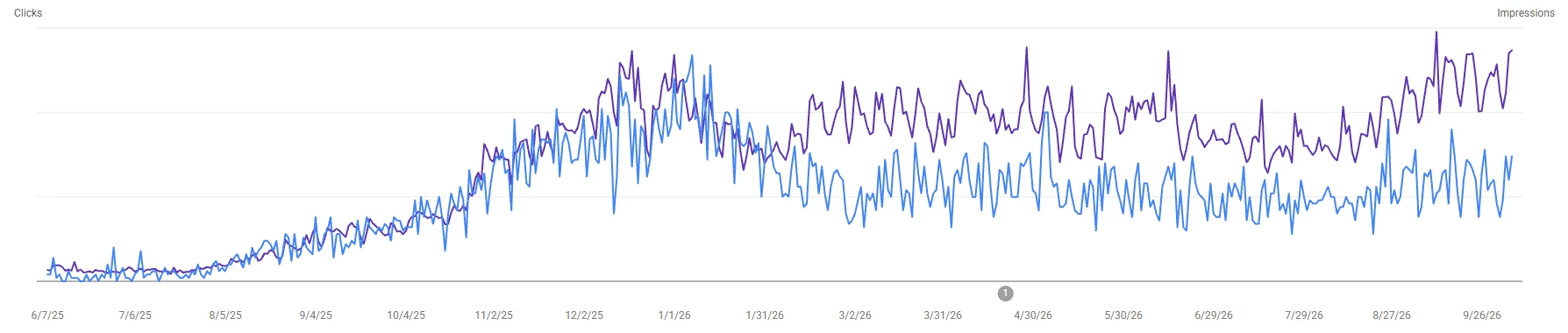
Over the same period, the established market’s property declined significantly. Average position drifted from the top ten to the low twenties, click-through rate fell, and clicks dropped to a fraction of their former level. Impressions held up much better than clicks.
The architecture solved the launch problem. It didn’t protect the mature property.
My read on why: the established property’s traffic leaned heavily on informational content, built with a strongly semantic approach of topical maps and broad informational coverage, in the style of Koray Tuğberk Gübür’s framework. Two changes hit exactly that layer. Google’s updates have cut back on informational articles from sites like this, and AI Overviews now answer many of those questions on the results page. Impressions holding up while clicks fell fits the second: the pages still appear, but fewer searchers need to click.
What I’d do differently
Build the mature property’s traffic on commercial intent. Informational content should support the pages that generate leads, not be the main source of traffic. Pages that answer comparison, provider and enquiry queries are much harder for an AI summary to replace.
Track AI answers per query group from the start. A group where impressions hold and clicks fall is a signal in its own right. Measuring AI Overview presence and citations alongside Search Console would have shown that pattern earlier, before it showed up in leads.